How To Plant Oil Palm With Minimal Capital and smallholder guide to growing successful and profitable Oil Palm
Saturday, December 8, 2012
Saturday, December 1, 2012
Costs and Benefits Analysis of Aquilaria Species on Plantation for Agarwood Production in Malaysia
By
Mohd Farid Mamat
Forest Research Institute Malaysia 52109 Kepong Selangor paridms@frim.gov.my
Both options, whether planting Aquilaria spp. integration with banana (Musa spp.) or planting Aqualaria spp. as a single crop for agarwood production are viable.
An investment return for planting Aqualaria spp. integrated with banana (Musa spp.) is much higher with an IRR of 54.85% compared with 38.49% for a single crop plantation.
The NPVs of investment at 10% discount for a 1,000 hectares integrated planting are RM185.6 million while the option involving single crop plantation for agarwood production is RM153.6 million.
The better present value of return of the option involving integration planting is attributed to the added and earlier revenue contribution from agriculture crop. The good demand and encouraging banana price over the years would make this option the preferred choice.
However, the establishment of Aqualaria spp. plantation solely for agarwood production also has its attraction. The option is not labour intensive. This speaks well for a rapidly developing country like Malaysia, where labour is no more a luxury relative to neighboring countries.
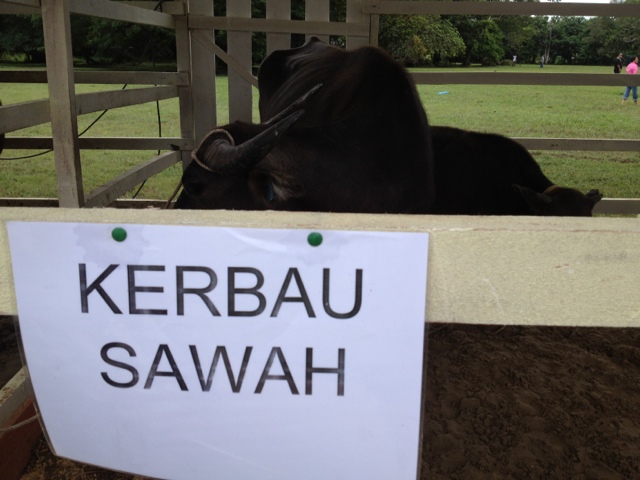
The buffaloes in Sarawak plantations
By Mahbob Abdullah
The Buffalo in Jenderata Estate, United Plantations, Perak.
As usual when I am in Sarawak I look forward to seeing the egrets. My father called them ‘bangau’ and he had told me long ago what they stood for.
Recently on the road from Bintulu to Selangau I saw the white birds as they stalked for insects in the grass. Elegant and confident, they flew and circled, and then landed again to go on feeding. They were used to people.
But now I thought there was something missing.
I had to think hard and I was reminded of the advice of a plantations director, Ken Eales whom I had once worked for. He did not talk much, he kept his distance, but one day on a plane journey when people tended to be a bit more relaxed, I had the chance to ask him about his way of management.
“As a leader I am not close to anybody. I can look at issues so that my likes and dislikes cannot cloud my judgement.”
From his wallet he took out a piece of paper and he read out, “This is what I remind myself. Believe none of what you hear, and half of what you see.”
“There is one more way I look at management,” he went on. He turned the paper over and read again: “Do not see what is there, you must also see what is not there.”
I remembered those words, and realised what I could not see among the egrets. Buffaloes.
When I was working in Sabah on a plantation in the Labuk valley, many years back, I had seen many egrets, but they were among the buffaloes on the plantations. The Bajaus in Kota Belud brought them upriver and I would buy them on behalf of the workers.
The male buffaloes pulled the carts loaded with oil palm bunches. Previously the harvesters carried the bunches in baskets slung on a pole over their shoulders, and the heavy weight had made them stagger to the roadside.
Now the buffaloes did the hard work. They even looked forward to the start of the day. Some could step up and lift the yoke with their horns and put them on their shoulders ready to pull the cart on the word ‘Jalan’. The owners treated them like pets.
The female buffaloes formed a breeding herd. With one hundred and fifty females I would put five bulls, which were selected for their size and temperament. A veterinary officer Paddy Kehoe would come upriver by boat from Sandakan to check the herd.
The use of buffaloes to pull the carts of bunches had come about by chance. In the early days of Pamol Sabah, one of the Filipino workers had brought a buffalo to pull a cart full of bunches. His headman wanted to sack him. He should carry the oil palm bunches like everybody else. At that time the estate manager, Leslie Davidson arrived on the scene.
“He is lazy, sir,” the headman said. “I want to sack him.”
When Davidson saw the buffalo working, he promised the headman he would be sacked.
“The only way you can keep your job is if you can get all the other harvesters to use buffaloes. Like he does.”
To help the harvesters, he arranged to start a breeding herd. At two years old the male buffaloes were put to work.
But even as they worked, the egrets would come to them. The birds would hop on their backs, and look for ticks and flies even in their ears, or waited near their feet to peck at insects that were disturbed in the grass.
But along the road in Sarawak I saw only egrets and few buffaloes. In the plantations I saw workers move the bunches in wheel barrows. Sometimes they used mini-tractors which they called the mechanical buffaloes. The first models appeared thirty years ago, and since then the prices of these machines have gone up many times, as has the price of diesel.
So in Sarawak the buffaloes should come back. Buffaloes now cost much less than a tractor. They feed on grass and their waste becomes fertiliser. The harvesters earn more with higher output. Fewer workers will be needed. A small premium per month will get an insurance cover against losses and thefts. It worked very well when I was running an estate.
As plantations expand and come into harvesting more buffaloes will be needed, especially in the land where there is no peat. Even on slopes the buffaloes can go on the hills, follow the terraces, work downhill and then home for the day. Later they would get a bath and the owners would give them a scrub, and a feed of fresh-cut grass.
Some readers may see this is a chance to start a buffalo farm and a breeding herd. In Indonesia I have seen healthy beasts in Aceh and in Tanah Toraja, pulling ploughs in the padi-fields. In the Nile valley of Egypt they are also raised for milk, made into ghee as cooking fat.
I have looked after buffaloes in my village in Rembau, I knew their characters and temperament, some were leaders, many were not, while a few were rebels. Each day after school I would take them out to graze but let them free after the rice harvest.
They remained in the open fields until the next planting season. Then I would go out and call them, they responded, and it was no problem to lead them back. It was even better if the buffalo had dropped a calf and it followed its mother home with you.
It was not long after the Japanese war that my father had told me about the egrets when they returned to the village. They had landed in the padi-fields.
“That is a sign that peace is with us again.”
My mother could recite to me the nursery rhyme “Bangau oh bangau” and today I can recite it completely with the help of the internet.
It would be great to see more buffaloes in Sarawak. There is plenty of grass, ample space, and water is in abundance. The state is virtually disease-free. Their population can grow with the pace of development in oil palm.
The egrets can feed with the buffaloes. It is a scene I would love to see. It is as green as you can get but don’t talk to the workers about selling their pets.
Read more: http://www.theborneopost.com/2012/12/02/the-buffaloes-in-sarawak-plantations/#ixzz2DqjxHtua
Palm Oil Set for Bear Market on Record Output, Mistry Says
Palm oil will probably tumble into a bear market next year as monthly output in Malaysia and Indonesia surges to records, compounding the impact of the biggest ever stockpiles, according to Godrej International Ltd.
Prices will drop below 2,200 ringgit ($723) a metric ton in August or earlier after trading between 2,300 ringgit and 2,600 ringgit between now and February, Dorab Mistry, director at Godrej, told a conference, giving his first outlook for 2013.
The most-active contract closed at 2,370 ringgit on the Malaysia Derivatives Exchange today, after touching a three-year low of 2,220 ringgit on Nov. 12.
Palm oil, used in everything from biofuels to noodles, fell 25 percent this year, extending a loss from 2011, as slowdowns in China and the European Union cut demand and boosted stockpiles.
Mistry’s forecast raises the prospect that prices may drop for three straight years in what would be the worst run of losses since at least 1996, according to data compiled by Bloomberg.
“I expect vegetable oil prices to remain range-bound in the first half of the year and to begin a major bear market in the second half,” Mistry said in Bali, Indonesia. “How low they will go is very difficult to predict at this stage.”
Rabobank Forecast
The outlook from Godrej contrasts with a forecast this week from Rabobank International, the world’s biggest agricultural lender, that picked palm oil to be the best-performing agricultural commodity in 2013. Prices will rise as inventories decline from record levels and demand increases from importers including China and India, the Amsterdam-based bank said in a report on Nov. 28.
Falling prices may contribute to lower global food costs in 2013, while paring profits and revenues at producers including Sime Darby Bhd. (SIME) and Golden Agri-Resources Ltd. (GGR)
Palm oil may trade between 2,500 ringgit and 3,000 ringgit for the next six months, supported by lower production in the first quarter of the next year and higher demand, Sime Chief Executive Officer Mohd Bakke Salleh said Nov. 27.
Output in Indonesia and Malaysia, which account for 87 percent of global production, may reach monthly records between September to December next year if weather remains normal, said Mistry.
Malaysia may produce a record 19 million tons in 2013, while Indonesian output may reach as much as 30 million tons, an all-time high, he said. Production is forecast at 18.4 million tons and more than 27.5 million tons this year, he said.
Monthly Loss
Futures dropped 5 percent in November, a third monthly loss. Mistry didn’t define what he meant by a bear market. A bear market is typically defined as a decline of 20 percent or more from a closing high and is compared with a closing low.
Prices may have bottomed out as stockpiles are set to decline amid a pick-up in demand from buyers including India, Thomas Mielke, executive director of Oil World, told the conference.
Futures may rebound to 3,100 ringgit to 3,200 ringgit between March and May, he said.
“Prices will strengthen quite a bit more than 2,600 ringgit as we’re in this inventory downcycle, which follows production,” Alvin Tai, an analyst at OSK Investment Bank Bhd., said by phone in Kuala Lumpur. Inventory in Malaysia may fall to about 1.6 million tons by May, he said.
Global food use of vegetable oils may grow by about 3.5 million tons as lower prices stimulate consumption, while biodiesel usage will expand 500,000 tons in the year that began on Oct. 1, said Mistry, who’s worked in the industry for 35 years. The increase in demand of 4 million tons will exceed incremental supply of 3.15 million tons, he said.
‘Heaviest Stocks’
The new season is starting with the “heaviest stocks in history” and this overhang will cushion the impact of the lower production of vegetable oils in the first half, said Mistry. Malaysia’s reserves climbed to a record of 2.51 million tons in October, according to the nation’s palm oil board. Stockpiles in Indonesia may be more than 4 million tons, Mistry said.
India, the biggest buyer of palm oil, started its new oil year with record inventories of 1.65 million tons, said Mistry. Domestic cooking oil output should expand this year due to a bigger mustard crop, he said. That may prompt the government to impose a 10 percent duty on crude palm oil imports and more than double taxes on refined oils to 20 percent, he said.
“I am bearish on the soya complex post-May with a gradual erosion of risk premium from as early as February,” he said. “Old crop soya oil needs to control demand and will therefore remain at a big premium to palm'
Soybean Oil
Soybean oil futures in Chicago may trade in a range of 48 cents and 53 cents a pound, while the new soybean oil crop from May onwards should see prices between $900 and $1,020 a ton on a free-on-board basis in Argentina, he said. Soybean oil for delivery in January traded at 49.92 cents today. Soybeans are crushed to make an oil that competes with palm oil.
Global economic growth is expected to be better in 2013, compared with this year, with the U.S. avoiding or resolving the so-called fiscal cliff, leading to a stronger dollar and gains for equities in most markets, said Mistry.
“The end of the cyclical bull market in commodities leads me to believe that profitability in agriculture and in plantations will soon revert to more normal levels,” he said. “The days of super-normal profits in palm oil cultivation are coming to a close.”
To contact the reporters on this story: Ranjeetha Pakiam in Kuala Lumpur at rpakiam@bloomberg.net; Yoga Rusmana in Jakarta at yrusmana@bloomberg.net
To contact the editor responsible for this story: James Poole at jpoole4@bloomberg.net
Friday, November 30, 2012
1.21 million hectares of land had been planted with oil palm
KUCHING: The involvement of a community leader in stealing fresh fruit bunches (FFBs) from oil palm plantations in Sg Asap has saddened Minister of Land Development Tan Sri Dr James Masing as it could deter potential investors to Sarawak.
“I am very disappointed to know that a ‘ketua masyarakat’ (community leader) is involved in stealing FFBs. I hope all the relevant authorities would throw the book on those involved otherwise investors will be discouraged to invest in
plantations in Sarawak,” Masing told The Borneo Post on the sidelines of the State Legislative Assembly (DUN) sitting here yesterday.
He added that the police would deal with the individual concerned without fear or favour.
On a related issue, Masing revealed that as of June 30 this year, some 1.21 million hectares of land had been planted with oil palm, an increase of 18.6 per cent compared to a year ago, with about 80.2 per cent of the area developed by the private sector.
“This is in line with the government policy for the private sector to spearhead the development of the palm oil industry in the state,” Masing said in his winding-up speech at the DUN sitting yesterday.
He also reiterated that the industry was a private driven sector and as such the budget associated with plantation industry was not reflected in his ministry’s budget allocation.
“Nevertheless, my ministry is tasked to supervise the growth of the industry. The amount of fund involved in the plantation industry under my charge was clearly spelt out in my winding-up speech last year,” he said.
On NCR land, Masing revealed that as of June 30 this year, some 181,106 hectares had been planted with oil palm compared to 173,483 a year ago.
Thus, the current perimeter survey exercise undertaken by the state government would facilitate NCR land owners to develop their land free of encumbrances, he stressed.
Masing also disclosed that Salcra had a total planted area of 50,115 hectares under oil palm, out of which 1,074 hectares were due for replanting besides the new areas totalling 5,286 hectares which were in various stages of development.
“Despite the decline in the average price of crude palm oil (CPO) and palm kernel (PK) for the first nine months of this year, Salcra and oil palm estates registered operating surplus of RM3.6 million and RM115.74 respectively.
“Similarly, Salcra’s palm oil mills in Bau, Serian and Saratok also achieved good profits before tax. Milling efficiency, coupled with continuous prudent cost control accompanied by effective and good management, has enabled Salcra and its participating landowners to achieve these commendable results,” said Masing.
He also reported that Felda had planted some 60,000 hectares with oil palm in the state by end of 10th Malaysia Plan.
He said Felda was embarking on the development of NCR land with some 500 hectares for oil palm under Phase I at Pasai-Siong near Sibu.
Meanwhile, the senior minister expressed his worry that that some 80 per cent of 98,092 workers presently employed by oil palm plantations in the state were Indonesians.
“As the industry in Indonesia is expanding very rapidly, it has become increasingly more difficult to get additional workers from that country, thus the state government is considering other source countries for the recruitment of foreign workers to ease the shortage.”
However, he pointed out that it would be a short term solution.
“Therefore there is an urgent need to come up with long term measures to resolve the problem of shortage of workers,” he said.
To him, the best solution was for local people to be willing to work in oil palm plantations and acquire skills so that they could command better salaries. He also highlighted the urgent need for more research and development (R&D) to increase mechanisation in field operations.
Read more: http://www.theborneopost.com/2012/11/28/thieving-community-leader-disappoints-masing/#ixzz2DkkJwyIP
Friday, November 23, 2012
Oil Palm Smallholders in Mukah
SIBU: Oil palm smallholders in Mukah and surrounding areas have made an urgent appeal to the government and the Malaysia Palm Oil Board (MPOB) to build a specific mill that would offer a standard price for their fresh fruit bunches (FFB).
Many of them are caught in a dilemma as the seven mills in Mukah are offering differing prices for their FFB.
As such they have no choice but to sell their products to the Sarawak Plantation Agriculture Development (SPAD), which currently offers the best price.
Unfortunately, they are forced to join a long queue if they desire so, depriving them of time, and causing great stress and hardship in their bid to sell their product.
Three smallholders, Sim Yau Chen, Kahim Byaru and Garai Badin, visited the PKR Lanang office yesterday to express their dissatisfaction with the MPOB and the government for refusing to look into their predicament.
“We have been waiting for a long time but MPOB appears to turn a blind eye to our request. We really hope MPOB, together with the government would give us some resolution,” Garai said.
Garai claimed he had to wait for two days on one occasion just to sell 15 to 20 metric tons of oil palm.
“The long queue is taking a heavy toll on our livelihood. If we join in the queue to sell our FFB, then there would not be anybody to take care of our business,” he said.
Kahim said the government and the MPOB were doing a disservice to them.
“On the one hand, they encouraged us to go into the oil palm industry but on the other hand, they are putting extreme pressure on us by refusing to lend support,” he said.
Kahim said they might be forced to quit the business if the mills continued to manipulate FFB prices.
PKR Lanang division chairman George Chen said the government and the MPOB should immediately step in to resolve this longstanding problem.
He said it was a waste of time and resources when smallholders are forced to wait by the roadside in front of SPAD’s office to sell their FFB.
“Naturally, the smallholders will choose the mills that offer the highest price and as a result they have to join in these long queues,” he said.
Chen said the situation worsened when other mills began ascribing a lower grade to the FFB before buying them while others chose to reject the FFB outright, saying it was not up to standard.
In the past, Chen said the mills offered a standard price for the FFB.
Recently, they had come up with different prices for different FFB grades, thus putting smallholders in a dilemma.
“If they want to sell their FFB to SPAD which offers the highest price at the moment, it would mean them having to sacrifice their time to join in the long queue,” he said.
Chen said under the grading system, one metric tonne for Grade A oil palm fetched RM661, Grade B RM567 and Grade C RM441.
Before the grading system, Chen said the smallholders used to sell their FFB at RM661.
“Now, some mills ascribe these FFBs under Grade C, hence offering RM441 per metric tonne. This is akin to robbing the smallholders of their hard work,” Chen said.
Meanwhile, a spokesman from MPOB when contacted by The Borneo Post yesterday said they would send enforcement officers to look into the matter immediately.
“There are various issues to look into including the quality and source of the FFB,” the spokesman added.
Read more: http://www.theborneopost.com/2011/09/23/mukah-oil-palm-smallholders-in-a-dilemma/#ixzz2D3CiwLAM
Subscribe to:
Posts (Atom)