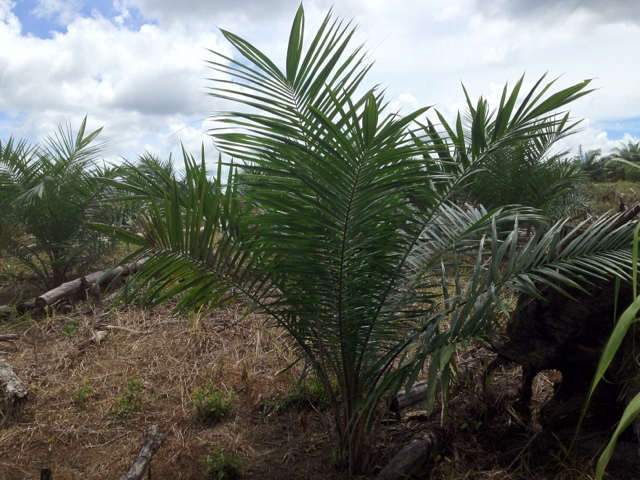
These are the pictures taken to compare the growth of AAR germinated seed purchased in april 2011 and planted in april 2012. Around 600 trees were planted at planting density of 200 trees per hectare.
How To Plant Oil Palm With Minimal Capital and smallholder guide to growing successful and profitable Oil Palm
Saturday, February 16, 2013
Friday, February 15, 2013
Palm Oil Stocks To Continue Downtrend Driven By Higher Exports, Says Rabobank
KUALA LUMPUR, Feb 15 (Bernama) -- Palm oil stocks, which fell 1.9 per cent last month, is expected to continue its downtrend in coming months, driven by strong export demand, says Rabobank Agri Commodity Market Research.
"We believe the drawdown will continue based on our first quarter 2013 price forecast of RM2,400 per tonne.
"However, we expect it to not push stocks below the five-year average. We maintain expectations that prices this year will remain lower year-on-year (y-o-y)," Rabobank said in a research report.
In the coming months, the seasonally slow palm oil production, palm oil's low price and reduced supplies of alternative vegetable oils should allow price to rise in the second quarter this year.
It said China's stricter quality requirements, effective January this year, have not appeared to have impeded Malaysia's palm oil exports to the country, which grew 23 per cent y-o-y to 268,000 tonnes and is likely to remain strong as other vegetable oil import supplies were limited.
Malaysia's palm oil exports to India, which rose 57 per cent to 172,000 tonnes in January, is also expected to continue until their rapeseed harvest is underway in March.
"Palm oil exports during the first 10 days of February were reported up 25 per cent month-on-month to 429,000 tonnes and at the same time, we expect production to continue declining.
"We expect Malaysia's palm oil output to fall an average of two per cent y-o-y during the next six months," it added.
-- BERNAMA
"We believe the drawdown will continue based on our first quarter 2013 price forecast of RM2,400 per tonne.
"However, we expect it to not push stocks below the five-year average. We maintain expectations that prices this year will remain lower year-on-year (y-o-y)," Rabobank said in a research report.
In the coming months, the seasonally slow palm oil production, palm oil's low price and reduced supplies of alternative vegetable oils should allow price to rise in the second quarter this year.
It said China's stricter quality requirements, effective January this year, have not appeared to have impeded Malaysia's palm oil exports to the country, which grew 23 per cent y-o-y to 268,000 tonnes and is likely to remain strong as other vegetable oil import supplies were limited.
Malaysia's palm oil exports to India, which rose 57 per cent to 172,000 tonnes in January, is also expected to continue until their rapeseed harvest is underway in March.
"Palm oil exports during the first 10 days of February were reported up 25 per cent month-on-month to 429,000 tonnes and at the same time, we expect production to continue declining.
"We expect Malaysia's palm oil output to fall an average of two per cent y-o-y during the next six months," it added.
-- BERNAMA
Thursday, February 14, 2013
Malaysia’s palm oil stockpiles fall on lower production
KUALA LUMPUR: Palm oil reserves in Malaysia, the world's second largest producer, declined in January for the first time since June, as output fell and shipments decreased less than expected.
Inventories fell 1.9% to 2.58 million tonnes last month from a record 2.63 million in December, Malaysian Palm Oil Board said in a statement yesterday.
Exports jumped 18% to 440,830 tonnes in the first 10 days of this month, from 373,462 tonnes in the equivalent period last month, cargo surveyor Intertek Testing Services said on Feb 9.
Reserves in Malaysia and Indonesia climbed last year as production outpaced demand, pushing down prices by 23%, the most since 2008. Rates may increase this year, as economies rebound in China and India, the world's biggest importers, the Indonesian Palm Oil Association said on Feb 5.
“The good news is that stockpiles seem to be declining while exports appear to be pretty strong,” Ivy Ng, an analyst at CIMB Group Holdings Bhd, said in Kuala Lumpur yesterday.
“This is still considered mildly positive though it's on the high end of the forecast range. Going into February, given that we have a bit of an advantage in terms of CPO (crude palm oil) export tax versus Indonesia, that should help continue to boost demand,” she said.
The drop in reserves to 2.58 million tonnes was less than the median estimate of a decline to 2.53 million tonnes in a Bloomberg survey. Output fell 10% to 1.6 million tonnes, while exports slid 1.6% to 1.62 million tonnes, it said.
Malaysia said in October that it would cut the export tax to between 4.5% and 8.5%, from about 23%, effective Jan 1, to cut record reserves. The tariff for last month and February was set at zero, as the base price was below the threshold that triggers the 4.5% rate.
Indonesia, the biggest grower, fixed the duty at 9% this month.
“The zero export tax is still giving a boost to the market,” Chandran Sinnasamy, head of trading at LT International Futures Sdn Bhd, said yesterday. “After the slowdown in the first half of January, the exports improved on the news that the export tax would remain at zero. February exports look like they may be better.”
Shipments in January were 1.46 million tonnes, 7% less than in December, according to Intertek data released on Jan 31. The decline over the full month compared with a 25% drop over the first 10 days of last month. - Bloomberg
Inventories fell 1.9% to 2.58 million tonnes last month from a record 2.63 million in December, Malaysian Palm Oil Board said in a statement yesterday.
Exports jumped 18% to 440,830 tonnes in the first 10 days of this month, from 373,462 tonnes in the equivalent period last month, cargo surveyor Intertek Testing Services said on Feb 9.
Reserves in Malaysia and Indonesia climbed last year as production outpaced demand, pushing down prices by 23%, the most since 2008. Rates may increase this year, as economies rebound in China and India, the world's biggest importers, the Indonesian Palm Oil Association said on Feb 5.
“The good news is that stockpiles seem to be declining while exports appear to be pretty strong,” Ivy Ng, an analyst at CIMB Group Holdings Bhd, said in Kuala Lumpur yesterday.
“This is still considered mildly positive though it's on the high end of the forecast range. Going into February, given that we have a bit of an advantage in terms of CPO (crude palm oil) export tax versus Indonesia, that should help continue to boost demand,” she said.
The drop in reserves to 2.58 million tonnes was less than the median estimate of a decline to 2.53 million tonnes in a Bloomberg survey. Output fell 10% to 1.6 million tonnes, while exports slid 1.6% to 1.62 million tonnes, it said.
Malaysia said in October that it would cut the export tax to between 4.5% and 8.5%, from about 23%, effective Jan 1, to cut record reserves. The tariff for last month and February was set at zero, as the base price was below the threshold that triggers the 4.5% rate.
Indonesia, the biggest grower, fixed the duty at 9% this month.
“The zero export tax is still giving a boost to the market,” Chandran Sinnasamy, head of trading at LT International Futures Sdn Bhd, said yesterday. “After the slowdown in the first half of January, the exports improved on the news that the export tax would remain at zero. February exports look like they may be better.”
Shipments in January were 1.46 million tonnes, 7% less than in December, according to Intertek data released on Jan 31. The decline over the full month compared with a 25% drop over the first 10 days of last month. - Bloomberg
CPO price will not go beyond RM2,800
Alliance Research says if there were to be a price rally for crude palm oil (CPO), it will not go beyond the RM2,800 per metric tonne level this year in view of the continued export competition with Indonesia and a healthy year-on-year production.
It also said that while stocks had reduced on a month-on-month basis, they remained high.
"This should see CPO prices recovering further in the coming weeks as shipment data is indicating a positive demand and we see that prices could trend up to RM2,800 per metric tonne over first quarter 2013." Alliance said in a note today.
It said that while the mild decline in inventories from improved usage of palm oil was expected to continue in February and likely to support CPO prices, it did not expect the price to go further up amid an anticipated volatile year.
It maintained an "underweight" recommendation on the sector, projecting CPO prices to average at RM2,6000 per metric tonne.
In a separate note, Hong Leong Investment Bank said a recent report had said that China's quarantine authorities have not rejected any palm oil cargoes from Malaysia in January as the quality was in line with the national standard.
"However, we remain cautious on such implementation for now, as we believe it may still be premature to conclude that such a risk has been eliminated."
The investment bank also maintained an "underweight" stance on the sector, saying that CPO price recovery would remain capped on demand risk from certain major palm oil consuming countries and higher CPO supply this year in the absence of weather disruptions.-- Bernama
Read more: CPO price not to go beyond RM2,800 http://www.btimes.com.my/Current_News/BTIMES/articles/20130214162936/Article/index_html#ixzz2Kv2A1200
It also said that while stocks had reduced on a month-on-month basis, they remained high.
"This should see CPO prices recovering further in the coming weeks as shipment data is indicating a positive demand and we see that prices could trend up to RM2,800 per metric tonne over first quarter 2013." Alliance said in a note today.
It said that while the mild decline in inventories from improved usage of palm oil was expected to continue in February and likely to support CPO prices, it did not expect the price to go further up amid an anticipated volatile year.
It maintained an "underweight" recommendation on the sector, projecting CPO prices to average at RM2,6000 per metric tonne.
In a separate note, Hong Leong Investment Bank said a recent report had said that China's quarantine authorities have not rejected any palm oil cargoes from Malaysia in January as the quality was in line with the national standard.
"However, we remain cautious on such implementation for now, as we believe it may still be premature to conclude that such a risk has been eliminated."
The investment bank also maintained an "underweight" stance on the sector, saying that CPO price recovery would remain capped on demand risk from certain major palm oil consuming countries and higher CPO supply this year in the absence of weather disruptions.-- Bernama
Read more: CPO price not to go beyond RM2,800 http://www.btimes.com.my/Current_News/BTIMES/articles/20130214162936/Article/index_html#ixzz2Kv2A1200
CPO Price in 2012
Crude palm oil futures (FCPO) on Bursa Malaysia Derivatives ended the week sharply higher due to the optimism of increasing demand in the coming months and short covering activities ahead of the holiday season end of the year.
The benchmark FCPO March contract surged RM133 or 5.84 per cent to close at RM2,409 per tonne on Friday from RM2,276 per tonne last Friday.
The trading range for the week was from RM2,296 to RM2,410.
Total volume traded for the week amounted to 157,246 contracts, down 30,991 contracts from the previous week.
The open interest as at Thursday increased to 159,084 contracts from 158,436 contracts the previous Thursday.
Palm oil market was cheered by the announcement from the Malaysian government on Monday that its crude palm oil export tax for January would be set at zero per cent in line with the analysts’ expectation the week earlier.
Such move would be able to boost demand for crude palm oil from those countries that are price-sensitive to vegetable oils like India, China and Pakistan.
This would also open up the opportunities for other palm oil suppliers to sell crude palm oil to overseas buyers without the restrictions of free export tax quota for crude palm oil which is only available to certain suppliers in Malaysia.
Cargo surveyor ITS released the palm oil export figures for the period of December 1 to 20 on Thursday at 1,004,159 tonnes, a slip of 1.89 per cent while another surveyor SGS at 1,015,440 tonnes, a slight increase of 0.50 per cent from the same period last month.
On the other hand, the soybean prices were under pressure this week as China had cancelled a total of 840,000 tons of soybean shipments this week.
The Chinese soybean importers expected the soybean prices would be ease from the current level with the anticipation of record soybean plantings from South America.
The weather in Brazil was favourable so far but the weather in Argentina was a bit wetter, slowing down the crop planting progress in key producing areas.
The current scenario may narrow the deep discount between palm oil and soybean oil prices which is hovering at US$350 per ton currently.
The Malaysian palm oil production may have a double digit fall in December as heavy rains disrupted the harvesting and transportation of the tropical oil.
On the economic front, the US fiscal cliff will still be on focus as it is approaching the expiry end of this year.
Most analysts viewed that the US policy makers would be able to close the deal to avert the fiscal cliff.
The Malaysian market will be closed on Tuesday celebrating Christmas day.
Technical View
The benchmark March contract finally broke up from the consolidation phase on Friday after the market had nicely covered most of the gap left in the chart due to change of month.
This breakout confirmed the market is ready for a rally soon. The target for this rally would be set at RM2,745 to RM2,820 levels.
Resistance would be pegged at RM2,490 and RM2,634 while support was set at RM2,350 and RM2,220.
Major fundamental news this coming week
Malaysian export data for December 1 to 25 by ITS and SGS on December 26.
Oriental Pacific Futures (OPF) is a Trading Participant and Clearing Participant of Bursa Malaysia Derivatives. You may reach us at www.opf.com.my Disclaimer: This article is written for general information only. The writers, publishers and OPF will not be held liable for any damage or trading losses that result from the use of this article.
Read more: http://www.theborneopost.com/2012/12/23/weekly-crude-palm-oil-report-december-23-2012/#ixzz2KsotPAwf
The benchmark FCPO March contract surged RM133 or 5.84 per cent to close at RM2,409 per tonne on Friday from RM2,276 per tonne last Friday.
The trading range for the week was from RM2,296 to RM2,410.
Total volume traded for the week amounted to 157,246 contracts, down 30,991 contracts from the previous week.
The open interest as at Thursday increased to 159,084 contracts from 158,436 contracts the previous Thursday.
Palm oil market was cheered by the announcement from the Malaysian government on Monday that its crude palm oil export tax for January would be set at zero per cent in line with the analysts’ expectation the week earlier.
Such move would be able to boost demand for crude palm oil from those countries that are price-sensitive to vegetable oils like India, China and Pakistan.
This would also open up the opportunities for other palm oil suppliers to sell crude palm oil to overseas buyers without the restrictions of free export tax quota for crude palm oil which is only available to certain suppliers in Malaysia.
Cargo surveyor ITS released the palm oil export figures for the period of December 1 to 20 on Thursday at 1,004,159 tonnes, a slip of 1.89 per cent while another surveyor SGS at 1,015,440 tonnes, a slight increase of 0.50 per cent from the same period last month.
On the other hand, the soybean prices were under pressure this week as China had cancelled a total of 840,000 tons of soybean shipments this week.
The Chinese soybean importers expected the soybean prices would be ease from the current level with the anticipation of record soybean plantings from South America.
The weather in Brazil was favourable so far but the weather in Argentina was a bit wetter, slowing down the crop planting progress in key producing areas.
The current scenario may narrow the deep discount between palm oil and soybean oil prices which is hovering at US$350 per ton currently.
The Malaysian palm oil production may have a double digit fall in December as heavy rains disrupted the harvesting and transportation of the tropical oil.
On the economic front, the US fiscal cliff will still be on focus as it is approaching the expiry end of this year.
Most analysts viewed that the US policy makers would be able to close the deal to avert the fiscal cliff.
The Malaysian market will be closed on Tuesday celebrating Christmas day.
Technical View
The benchmark March contract finally broke up from the consolidation phase on Friday after the market had nicely covered most of the gap left in the chart due to change of month.
This breakout confirmed the market is ready for a rally soon. The target for this rally would be set at RM2,745 to RM2,820 levels.
Resistance would be pegged at RM2,490 and RM2,634 while support was set at RM2,350 and RM2,220.
Major fundamental news this coming week
Malaysian export data for December 1 to 25 by ITS and SGS on December 26.
Oriental Pacific Futures (OPF) is a Trading Participant and Clearing Participant of Bursa Malaysia Derivatives. You may reach us at www.opf.com.my Disclaimer: This article is written for general information only. The writers, publishers and OPF will not be held liable for any damage or trading losses that result from the use of this article.
Read more: http://www.theborneopost.com/2012/12/23/weekly-crude-palm-oil-report-december-23-2012/#ixzz2KsotPAwf
Tuesday, February 5, 2013
Oil Palm Price on the increase
KUALA LUMPUR: Crude palm oil futures closed mostly higher yesterday on lower soyabean output and this pushed soyabean oil production down, said a dealer.
He said this attracted participants and reduced stocks.
Kenanga Deutsche futures dealer, Chan Chee Wei, said the South American weather was to blame for the lower soyabean output.
February 2013 lost RM17 to RM2,495 a tonne, March 2013 rose RM12 to RM2,540, April 2013 added RM7 to RM2,564 and May 2013 rose RM8 to RM2,584.
Turnover fell to 32,005 lots from 45,100 lots while open interest eased to 198,360 contracts from 213,363 recorded previously.
He said this attracted participants and reduced stocks.
Kenanga Deutsche futures dealer, Chan Chee Wei, said the South American weather was to blame for the lower soyabean output.
February 2013 lost RM17 to RM2,495 a tonne, March 2013 rose RM12 to RM2,540, April 2013 added RM7 to RM2,564 and May 2013 rose RM8 to RM2,584.
Turnover fell to 32,005 lots from 45,100 lots while open interest eased to 198,360 contracts from 213,363 recorded previously.
Sunday, February 3, 2013
10 Months After Field Planting
Weed control
The basin area of oil palm is kept free of weed growth through ring weeding. It is more important for young palms, roots of which are to be kept free from competition from weed. Depending on the extent of weed growth and rainfall, hand weeding is carried out even upto four times in a year during early years of the plantation which is progressively reduced to two rounds a year.
Herbicide application has become common in recent years. Care must be taken in the choice of herbicide and its application to prevent the damage of young palms. It is recommended to preferably apply contact herbicides rather than translocated herbicides. Translocated herbicides like Paraquat which is inactivated when contacted with soil are also used. Herbicides such as 2, 4-D, 2, 4-5-T, halogenated aliphatic acids Dalapon and TCA are found to produce abnormalities in oil palm seedlings and are to be avoided. Herbicide mixtures of 2 kg a.i. of Paraquat with 3 - 4 kg Atrazine Monuron and Diuron per ha sprayed/ground applied twice a year has been found to give control of weeds.
The basin area of oil palm is kept free of weed growth through ring weeding. It is more important for young palms, roots of which are to be kept free from competition from weed. Depending on the extent of weed growth and rainfall, hand weeding is carried out even upto four times in a year during early years of the plantation which is progressively reduced to two rounds a year.
Herbicide application has become common in recent years. Care must be taken in the choice of herbicide and its application to prevent the damage of young palms. It is recommended to preferably apply contact herbicides rather than translocated herbicides. Translocated herbicides like Paraquat which is inactivated when contacted with soil are also used. Herbicides such as 2, 4-D, 2, 4-5-T, halogenated aliphatic acids Dalapon and TCA are found to produce abnormalities in oil palm seedlings and are to be avoided. Herbicide mixtures of 2 kg a.i. of Paraquat with 3 - 4 kg Atrazine Monuron and Diuron per ha sprayed/ground applied twice a year has been found to give control of weeds.
Subscribe to:
Posts (Atom)