Tuesday, December 30, 2014

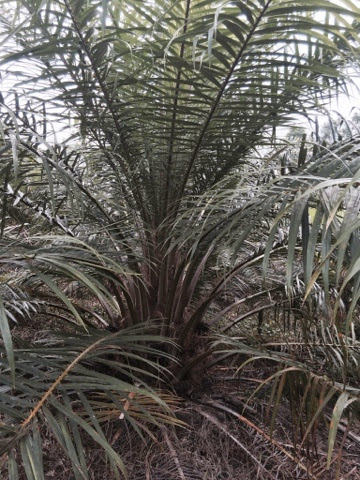
AA DxP seedlings after 29 months of field planting

The oil palm is a very precocious crop, which comes into maturity at 25 months or earlier from field planting, with peak yield realized at four or more years thereafter.

As early bearing and high yields in the field are mainly dependent on production of uniformly good and healthy seedlings from a nursery, it follows that good nursery management would be required to achieve the latter.

The production of superior oil palm planting materials is fully dependent on attention to details at all stages in the nursery management and this entails following closely, proven standards and procedures.

Oil palm has an economic productive life span of 20 years or more and any shortcomings in the planting material will have long term consequences on yield. As such, the grower must select and plant only the best in his field in order to maximize his yields.


My planted AA DXP bear fruits after 29 months of field planting are now ready for harverting.

Floods push up palm oil, rubber prices

BANGKOK: Rubber entered a bull market and palm oil headed for the longest run of gains in more than a decade as flooding across Malaysia and parts of Thailand hurt supplies of both commodities and forecasters predicted more rain.

Rubber for June delivery rallied 3.9% to 213.3 yen a kg (US$1,773 a tonne) on the Tokyo Commodity Exchange, the highest settlement since July 3. Futures rose 22% from a five-year low in October, meeting the threshold for a bull market with a gain of at least 20%. Palm oil climbed for a ninth day in Kuala Lumpur to head for the longest run of gains since 2002, according to data compiled by Bloomberg.

Heavy rains flooded parts of Malaysia and southern Thailand over the past two weeks, and Commodity Weather Group predicted the falls will continue for at least another week. Malaysia evacuated more than 200,000 people as of Monday amid the worst flooding in decades. Thailand is the world’s largest rubber exporter and neighbour Malaysia is the biggest shipper of palm oil after Indonesia, where some rubber exporters are in talks with buyers to reschedule shipments because of rains.

“Key growing areas are inundated,” said David Ng, a Kuala Lumpur-based derivatives specialist at Phillip Futures Sdn Bhd, referring to palm-growing estates in Malaysia. “Delayed harvesting activities and seasonally lower production will hamper yield levels in coming weeks.”

Palm oil for March delivery rose as much as 0.8% to RM2,305 a tonne on Bursa Malaysia Derivatives and traded at RM2,290 at 3:16 pm. The commodity climbed to RM2,308 on Monday, the highest level since Nov 4.

Some Indonesian rubber exporters are in talks with buyers to reschedule shipments, Rusdan Dalimunthe, executive director of the Rubber Association of Indonesia, or Gapkindo, said in a phone interview from Jakarta yesterday. Rubber production might drop 30% because of rain and floods, Dalimunthe said.

Rubber supplies in Thailand and Malaysia will contract by at least 100,000 tonnes a month if floods persist, International Rubber Consortium chief executive officer Yium Tavarolit said Monday. The group is the operating arm of the International Tripartite Rubber Council, which represents governments and exporters from Thailand, Indonesia and Malaysia.

Rubber futures rose 16% this quarter, the first advance since 2013, after Thailand, Indonesia and Malaysia took steps to shore up prices from the five-year low in October. Producer groups from the top suppliers pledged to refrain from selling below US$1.50 a kg. Three nations also agreed to cut exports from next year to drain supplies.

“Bad weather in Malaysia and Thailand boosted concern that supply may tighten,” Gu Jiong, analyst at commodity broker Yutaka Shoji, said by phone from Tokyo, referring to rubber.

In Malaysia, monsoon rains with strong winds are seen over Pahang, Perlis, Kedah, northern Perak, Kelantan, central and northern Terengganu, western Johor and Sabah, and are expected to continue until today, the Malaysian Meteorological Department said on its website. – Bloomberg


Thursday, December 11, 2014

Futures Crude Palm Oil (FCPO) benchmark February 2015 contract settled at 2,170

Futures Crude Palm Oil (FCPO) benchmark February 2015 contract settled at 2,170, down 69 points or 3.18 per cent from 2,239 last Friday.

Trading volume increased to 153,500 contracts from 145,407 contracts from last Monday to Thursday.

Open interest based on decreased to 829,380 contracts from 854,849 contracts from last Monday to Thursday.

Cargo surveyor, Intertek Testing Services (ITS) reported that exports of Malaysian palm oil products during November 1 to 25 decreased 2.9 per cent to 1.103 million tonnes compared with 1.135 million tonnes during October 1 to 25.

In a separate report, Societe Generale de Surveillance (SGS) reported that Malaysia’s palm oil exports during November 1 to 25 decreased 3.3 per cent to 1.099 million tonnes compared with 1.137 million tonnes during October 1 to 25.

Demand from the European Union (EU) fell, while demand from China, India, and US had picked up.

Spot ringgit weakened on Friday to 3.3810, to near a five-year low.

This was due to the selling off of the currency by offshore funds, triggered by growing fears of lower oil prices which could damage the economy.

The Malaysian government announced that it plans to scrap fuel subsidies, in order to save the country RM20 billion a year.

The Malaysian Palm Oil Association (MPOA) estimated that crude palm oil production in November could increase 2.4 per cent during November 1 to 20 compared with the previous month.

Initially, the price fell, due to the strengthening ringgit pressuring the price lower.

The price continued to drop, near to a one month low, due to poor export data and the expectation of increase in crude palm oil output in November.

However, the price then climbed heavily, recuperating losses made in the earlier session.

The price continued to rise, due to investors technical buying and short covering, although weaker crude oil prices paired with a stronger ringgit limited gains.

The price then fell, due to falling crude oil prices, reaching their lowest level in four years, which increased worries that palm oil may lose its attractiveness as a bio-fuel.

By the end of the week, the price fell significantly, to a five-week low, due weakening in crude oil prices.


Technical analysis

According to weekly FCPO chart, the price fell, testing middle Bollinger band, closing above.

According to the daily FCPO chart, the price dropped, testing psychological level 2,200, closing above.

The price continued to fall, testing support line 2,190, while eventually closed above psychological level 2,200, as the price increased recovering losses made in earlier session.

The price continued to climb, testing middle Bollinger band, closing below.

The price then fell, testing psychological level 2,200, closing above.

The price continued to fall, testing support line 2,150 and lower Bollinger band, closing above.

In the coming week, the price has potential to range 2,150 to 2,240.

Resistance lines will be placed at 2,210 and 2,250, while support lines will be positioned at 2,150 and 2,210.

These will be observed in the coming week.


Major fundamental news this coming week

ITS and SGS report on December 1 (Monday).

Oriental Pacific Futures (OPF) is a Trading Participant and Clearing Participant of Bursa Malaysia Derivatives. You may reach us at www.opf.com.my. Disclaimer:  This article is written for general information only. The writers, publishers and OPF will not be held liable for any damage or trading losses that result from the use of this article.


Read more: http://www.theborneopost.com/2014/11/29/crude-palm-oil-weekly-report-november-29-2014/#ixzz3LaFZZ8Ub


AAR palm after planted in 2012

Saturday, November 8, 2014

General Worker in the Plantation

The post of general worker in the plantation.
Duties: Harvesting palm fruit, fertilizing, applying insecticide and to do general works.

Harvesting ripen fruits and collecting dispersed fruits
Experience: Not necessary. Training will be provided.
Qualification: physically fit
Wages: RM33.00 daily
Age: 18 years and above
Place of employment: 

Friday, November 7, 2014

28 months after field planting

My palm begin fruiting 28 months after field planting. Selected harvest  on certain ripe fruit. 


Thursday, November 6, 2014

Weather in Malaysia and Indonesia to impact CPO production

KUALA LUMPUR: Dryness in certain areas in Malaysia and Indonesia this year will also likely impact crude palm oil (CPO) production in 2015, but bodes well for the commodity price, Maybank Kim Eng said.

It said 2015 CPO supply growth would be muted compared to the relatively good harvest this year and the research house has maintained a "neutral" view on the sector with an unchanged 2015-2016 CPO average selling price forecast of RM2,600 a tonne.

"The key upside risk to our view is weather anomalies, while the downside risk is a further decline in the crude oil price," it said in a research note today.

It said industry players are also in consensus over the CPO price outlook, citing concerns over the bumper US soybean harvest, ample supply of palm oil and low crude oil prices as key reasons.

Furthermore, it said Indonesia's third biodiesel tender in September, aimed at supplying the commodity to East Indonesia and priced at plus 3.47 per cent to cover transportation costs, would lend further support to demand.

Other factors it said are the slowing down of new planting in Indonesia in recent years as planters enter more difficult areas, increasingly stricter RSPO requirements and higher compensations required by local governments and the community.

It said some greenfield land in Indonesia is also deemed "grey areas" and "unplantable" due to overlapping mapping claims by the agricultural, forestry and mining ministries.-- Bernama

Wednesday, October 29, 2014

MPOC expects CPO prices to increase next year

KUALA LUMPUR: The Malaysian Palm Oil Council (MPOC) expected crude palm oil price (CPO) to increase to between RM2,100 and RM2,500 next year, lifted by factors such as biofuel demand and petroleum price level.


Its chief executive officer, Tan Sri Yusof Basiron, said besides supply and demand, biofuel demand and petroleum price level would determine whether more or less of biodiesel would be used.

“The announcement by Plantation Industries and Commodities Minister, Datuk Seri Douglas Uggah Embas, to impose a requirement for biodiesel to use seven per cent palm oil, from five per cent now, was a way to firm up the CPO price,” he said.


Basiron said this on the sidelines of MPOC’s International Palm Oil Trade Fair and Seminar 2014 here yesterday.

Uggah had said the move aimed to lower stocks and boost prices that had declined by over 20 per cent this year.

Basiron said the government also tried to remove depressing factors on prices by providing export duty exemption for CPO.

“This would remove any bearish factors affecting palm oil price.

“The move will also stimulate the country’s export and help rationalise the stock level as the palm oil output was entering a low production cycle,” he said. — Bernama


Read more: http://www.theborneopost.com/2014/10/29/mpoc-expects-cpo-prices-to-increase-next-year/#ixzz3HXXNssOZ